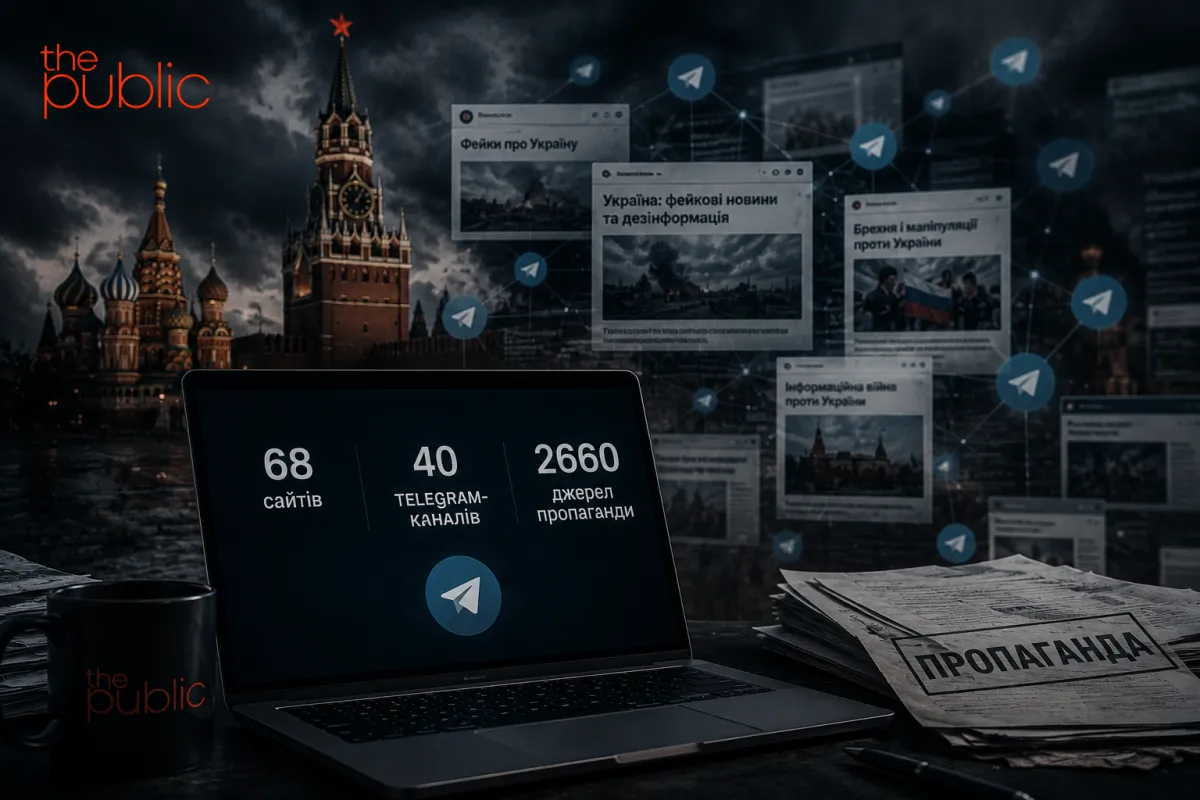
68 websites, 40 Telegram channels and 2,660 sources of propaganda. How the Kremlin spreads disinformation about Ukraine

The study covers the period from January 2025 to May 2026 and analyses how Russia is attempting to undermine support for Ukraine’s accession to the European Union.
The authors of the report emphasise that these are not random disinformation attacks. The Russian campaigns are described as a coordinated, multi-layered and increasingly sophisticated operation, targeting both Ukrainian audiences and citizens of EU countries simultaneously.
The main aim of this operation is not merely to spread falsehoods. The Kremlin is attempting to undermine confidence in Ukraine’s reforms, to portray Ukraine’s accession to the EU as an allegedly impossible or dangerous process, and to create the impression that European integration is harmful to both Ukraine and Europe itself.
How the network works
The report describes four levels of Russia’s information infrastructure.
The first level consists of Russia’s official state channels and state media. It is these that formulate the core messages. Among the sources mentioned in the study are RIA Novosti, TASS, RT, as well as Telegram channels run by Russian officials and state bodies, including Dmitry Medvedev, Maria Zakharova, the Russian Ministry of Foreign Affairs and the Russian Ministry of Defence.
These messages are then picked up by resources linked to or close to the Russian state. They adapt the propaganda for a Ukrainian audience via anonymous Telegram channels, pseudo-news websites, social media and supposedly local media outlets.
The study specifically mentions the ZOV network.
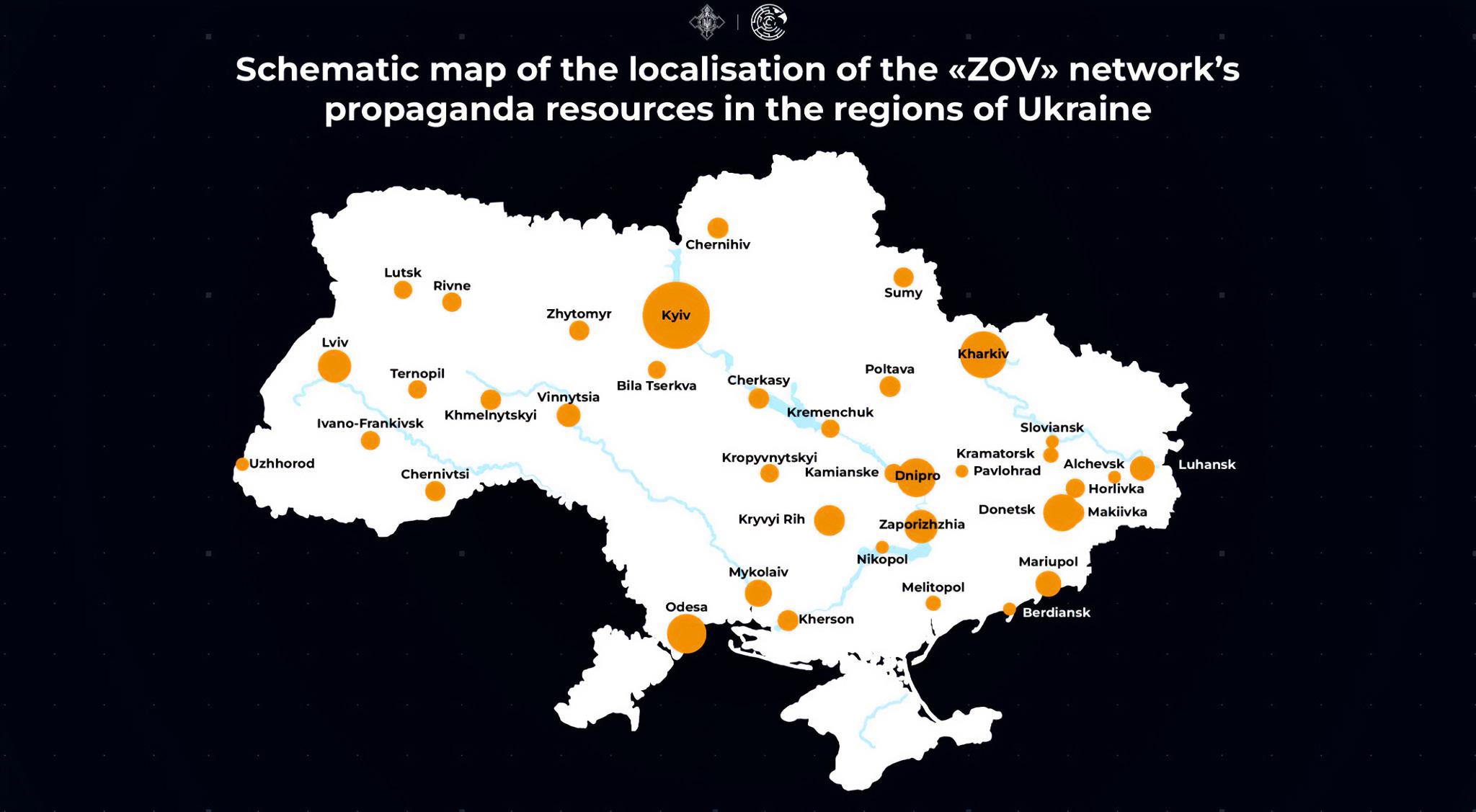
According to the Centre for Countering Disinformation, it consists of 68 websites, 40 Telegram channels and 40 VK pages. Its content has been localised for 23 regions of Ukraine and 17 major Ukrainian cities.
Why Telegram remains a vulnerability
Despite the blocking of Russian state media in Ukraine, their messages continue to reach Ukrainian audiences via Telegram and associated channels.
The study notes that the official websites of Russian state bodies are inaccessible within the Ukrainian information space, but the corresponding Telegram channels remain open to users. Similarly, Russian state media whose websites are blocked retain access to their audience via Telegram.
This is significant given Telegram’s role in Ukrainian media consumption. The report cites Ipsos data from 2025, according to which 62 per cent of Ukrainians regard Telegram as a source of news and information.
How the Kremlin spreads disinformation
The authors of the study describe the Russian information campaign as a multi-tiered system in which each tier performs a distinct function.
At the first level are state bodies and official Russian media outlets. It is these that shape the main propaganda narratives. The report names the Russian Ministry of Foreign Affairs, the Russian Ministry of Defence, RT, RIA Novosti, TASS, as well as the Telegram channels of Dmitry Medvedev, Maria Zakharova and other Russian officials among such sources.
The messages then move on to the second tier — an anonymous network that tailors them to a specific audience.
The study explicitly names the Telegram channels ‘Resident’, ‘Legitimny’, ‘Kartel’, ‘Spletnitsa’ and others. The authors note that the Security Service of Ukraine has linked them to the 85th Main Centre of the Special Services of the Main Directorate of the General Staff of the Russian Armed Forces.
The researchers also include information resources linked to Viktor Medvedchuk within this same ecosystem, in particular the ‘Drugaia Ukraina’ platform.
Well-known media figures are being drawn into the campaign
A separate tier of the information network consists of public figures who disseminate these same narratives under the guise of their own analysis or criticism of the Ukrainian authorities.
The report mentions the channels of Oleksiy Arestovych, Diana Panchenko and Anatoliy Shariy.
The authors of the study note that their role is not merely to repeat Russian talking points. Such speakers add an emotional dimension to them and build trust among an audience that may not readily accept openly pro-Russian sources.
Russian propaganda operates even at the level of individual towns
Another feature of the campaign is the use of pseudo-local media.
The study refers to the ZOV/‘Pravda’ and ‘Na Samom Dele’ networks, which created separate news platforms for various Ukrainian cities and regions.
According to the authors, such resources help the Kremlin adapt nationwide propaganda narratives to local fears and concerns.
That is why the network comprised 68 websites and 40 Telegram channels, and was tailored to 23 regions and 17 major cities in Ukraine.
What kind of disinformation is the Kremlin promoting?
Most often, Russian campaigns are built around a few recurring narratives.
The first is the claim that the EU is using Ukraine to weaken Russia, and that this is why it supports the war. This narrative shifts the blame for Russian aggression onto the European Union and aims to separate Ukraine’s security interests from its European course.
The second is the claim that EU countries are seeking to divide Ukraine. The report mentions fabricated scenarios about ‘Franco-British plans’ concerning Ukrainian territories, as well as the mythical Hungarian ‘Operation Turul’ regarding Transcarpathia. Such messages are specifically tailored to regional fears and historical memory.
The third is the claim that European integration amounts to external control over Ukraine. In this narrative, the reforms required for EU accession are presented not as modernisation, but as coercion from Brussels.
The fourth narrative is that Ukraine is supposedly incompatible with European values. To this end, Russian campaigns exaggerate the real problems with reforms, exploit the issue of corruption and take statements by European officials out of context.
How fake news is disguised as local news
One of the most important techniques described in the study is localisation. The Kremlin does not simply disseminate the same messages to everyone. Narratives are adapted to specific regions, cities, historical traumas and social groups.
For example, for a Ukrainian audience, propaganda might claim that Hungary is allegedly planning to take Transcarpathia, and Romania Bukovina. Such messages are more effective because they are tied to familiar regional issues and fears.
The report also describes so-called ‘mapaganda’ – the manipulative use of maps. Propagandists create or disseminate maps featuring fictitious ‘zones of responsibility’, purported plans to partition Ukrainian territory, or distorted front lines. Such visual materials appear convincing to some members of the audience, even though they are based on falsehoods.
How real statements by politicians are used
Another tactic is taking real statements out of context. The study notes that Russian campaigns take individual phrases from European politicians, experts or the media and present them as though there is no longer any support for Ukraine within the EU, or as though the country’s accession to the European Union is impossible.
This is more dangerous than a blatant fake, as the manipulation is often based on a genuine quote. The problem is that it is translated in a distorted manner, presented selectively, or a single opinion is portrayed as the supposed position of the entire EU.
Separately, the authors describe ‘event-hijacking’—the use of real events to revive old narratives. These include international conferences, elections, statements by officials, anniversaries or security incidents. Russian media outlets are quick to fit such events into a pre-existing propaganda framework.
Why Ukraine is not the only target
The study draws an important conclusion: Russian propaganda is increasingly reorienting itself towards audiences in EU countries.
The reason is that support for EU accession remains high among Ukrainians, whilst public and political opinion within the European Union is becoming a decisive factor for further enlargement. The Kremlin is therefore attempting to influence voters in European countries by portraying Ukraine as corrupt, dangerous or too costly for European taxpayers.
According to the study, propaganda tends to play on economic fears when targeting a German audience. For a French audience, it focuses on corruption and conspiracies. For a Polish audience, it plays on fears surrounding Ukrainian refugees and historical conflicts, particularly the issues of Volhynia and Eastern Galicia.
What AI and fake ‘experts’ are doing
The authors of the study also warn of the growing role of artificial intelligence in Russian information campaigns. AI makes it possible to produce large volumes of manipulative content in various languages quickly and cheaply.
Pseudo-experts are used separately. They present arguments that align with Russian propaganda as if they were independent analysis. The study notes that such commentators may refer to genuine documents, discussions or publications, but draw manipulative conclusions from them.
This is precisely how propaganda becomes not merely a collection of false messages, but an entire information environment in which the audience is overwhelmed with contradictory signals, erodes trust in official sources and creates the illusion of widespread dissatisfaction with Ukraine’s European integration.
What is the main risk?
For Ukraine, the main risk does not lie in an immediate collapse of support for EU accession. The authors of the study point to something else — the gradual build-up of doubts amongst vulnerable sections of the population.
These include people exhausted by the war, economically vulnerable groups, residents of regions targeted by pseudo-local narratives, as well as users who get their news mainly from Telegram or short-form video platforms.
For Europe, the risk lies in the fact that these same narratives can be transferred between countries. Messages aimed at a Ukrainian audience are subsequently adapted for EU countries, where they can fuel enlargement fatigue, doubts about financial support for Ukraine, or fear of Ukrainian refugees.
The authors of the study call on Ukraine, the EU and international partners to move away from reactively debunking individual pieces of disinformation towards systematically countering the entire infrastructure of manipulation.
This involves sharing data on networks and actors, the early detection of information operations, sanctions against organisers and associated resources, cooperation with digital platforms, the use of legal instruments and the promotion of media literacy.
The report’s main argument is simple: as long as Russian propaganda operates as a system, the response must also be systematic. Otherwise, isolated debunking of fake news will not stop a network capable of rapidly changing its names, platforms, languages and target audiences.
Follow us on Telegram