Billions on paper: why tax audits do little to boost the budget

This is evidenced by the Business Ombudsman Council’s analysis of the results of tax audits. MP Nina Yuzhanina also drew attention to this data on her Telegram channel, linking the issue to a report by the State Tax Service regarding high-risk foreign economic transactions worth over 198 billion hryvnias.
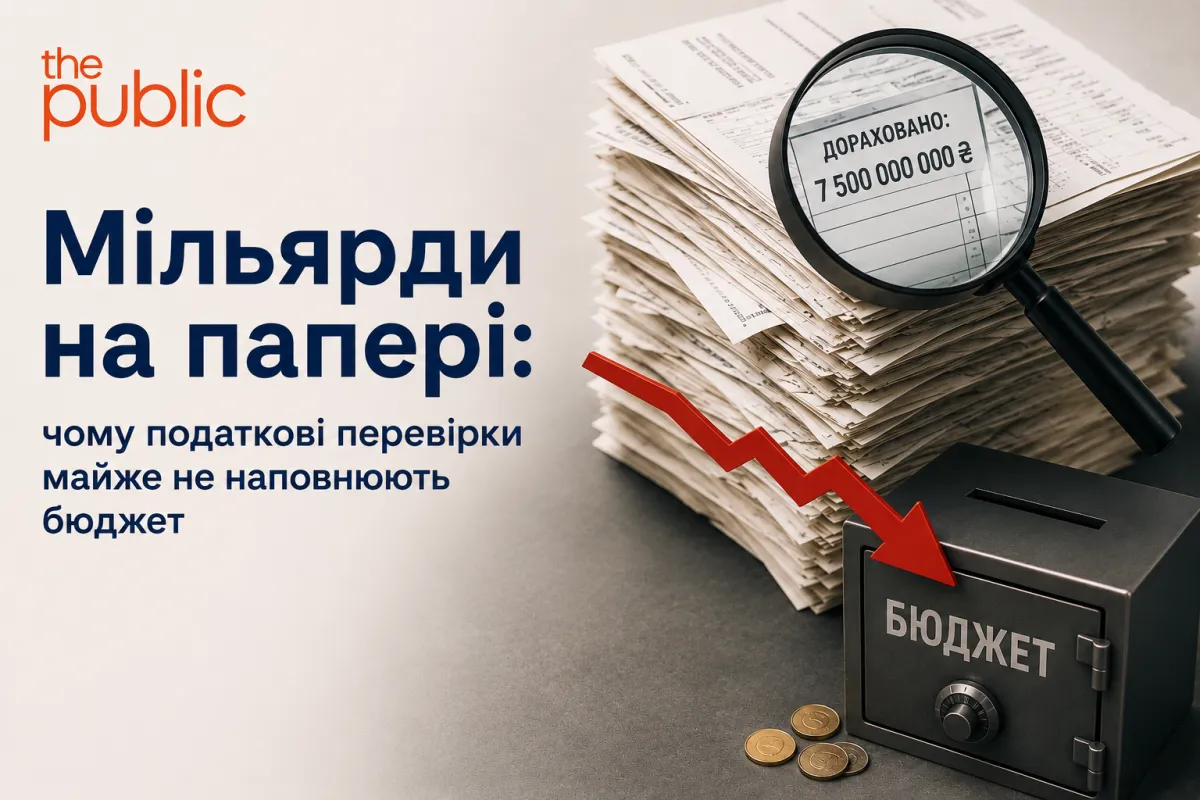
Tax audits in Ukraine are resulting in ever-increasing amounts of additional tax assessments, yet their actual impact on the budget remains low.
According to the Business Ombudsman Council, in 2017 the tax authorities assessed additional tax liabilities of 34 billion UAH, in 2021 – 90 billion UAH, and in 2023 – 75 billion UAH. In 2024–2025, the amounts of additional tax assessments were almost twice as high as in 2023.
At the same time, only 4.2–4.5% of the additional amounts actually reached the budget. In other words, over 95% of the funds identified following audits did not become actual revenue.
How much does the budget actually receive?
Given these figures, actual revenue from tax audits amounts to just over 6 billion UAH per year.
This means that large amounts of additional tax assessments do not always indicate the effectiveness of tax control. Some of these amounts may be appealed, cancelled or converted into tax debt, which the budget does not actually receive.
That is why the key indicator of audit effectiveness is not the volume of additional tax assessments, but how much money actually flows into the state budget.
A scheme worth 198 billion hryvnias
A specific example of the problem was the State Tax Service’s information regarding high-risk foreign economic transactions.
The State Tax Service reported signs of a large-scale scheme to transfer funds abroad via more than 2,300 high-risk companies. According to the tax authority, these companies carried out foreign economic transactions worth over 198 billion UAH, after which they effectively ceased operations or disappeared from the regulatory authorities’ radar.
The service noted that such companies shared common risk indicators: a short period of operation, no physical address, identical IP addresses and no employees.
Why 70 billion hryvnias did not become budget revenue
Following audits in this case, the tax authorities imposed additional penalties of over 70 billion hryvnias for breaches of foreign exchange legislation in the sphere of foreign economic activity.
However, these funds did not reach the budget. As Nina Yuzhanina noted, they effectively became tax debt.
In her view, this explains the record increase in tax debt in 2025 by 103 billion hryvnias. At the same time, the mere fact that such sums were assessed does not mean that the state actually received this money.
Questions regarding financial monitoring
Yuzhanina also raised questions regarding the financial monitoring system.
She noted that when it comes to transactions worth hundreds of billions of hryvnias, which showed signs of being fictitious and resulted in the non-repatriation of foreign currency proceeds, it is necessary to ascertain whether information about them was present in the financial monitoring system.
In particular, the MP asked whether the banks had seen these transactions, whether the relevant data had been received by the State Financial Monitoring Service, and whether the information had been passed on to law enforcement agencies as part of inter-agency cooperation.
What is the systemic problem
The situation with tax audits highlights the gap between the formal results of scrutiny and the actual revenue collected for the budget.
On the one hand, the tax authorities report tens of billions of hryvnias in additional tax assessments. On the other hand, most of these sums do not reach the budget, and some are converted into debt.
This raises the question of how the effectiveness of tax control should be assessed: by the amounts the tax authorities have assessed on paper, or by the money the state has actually received.
Why this matters for business and the budget
For the budget, a low level of actual collection means that tax audits are not delivering the expected financial results.
For businesses, this can mean additional pressure, protracted disputes, appeals against decisions and uncertainty. If the majority of additional tax assessments are not backed up by actual revenue, questions arise not only about the taxpayers but also about the quality of the audits themselves.
Ultimately, the state ends up with large figures in its reports but a significantly smaller result in the budget.
Follow us on Telegram