The Ministry of Internal Affairs presented an information box to support people released from captivity

An information box has been created in Ukraine to support people released from captivity. It was developed as part of the All-Ukrainian mental health programme "How are you?", initiated by the First Lady of Ukraine, Olena Zelenska.
This was reported by the Ministry of Internal Affairs of Ukraine.
The new tools are designed to help people released from captivity on their path to recovery, adaptation and return to a full life. They can be used not only by former captives themselves, but also by their relatives, comrades, colleagues, media representatives, civil servants and community representatives.
Reference book for those released from captivity
One of the key tools is the guidebook "Life and Service after Captivity."
It contains step-by-step recommendations on:
- reintegration after release;
- medical and psychological recovery;
- social adaptation;
- interaction with family and community.
The guide also covers issues of military service, financial literacy, housing programmes, education, employment and the development of veteran businesses.
Separate sections are devoted to cybersecurity, countering fraud, and information and psychological operations (IPO). The end of the publication contains useful contacts and regulatory documents.
Educational series on support after captivity
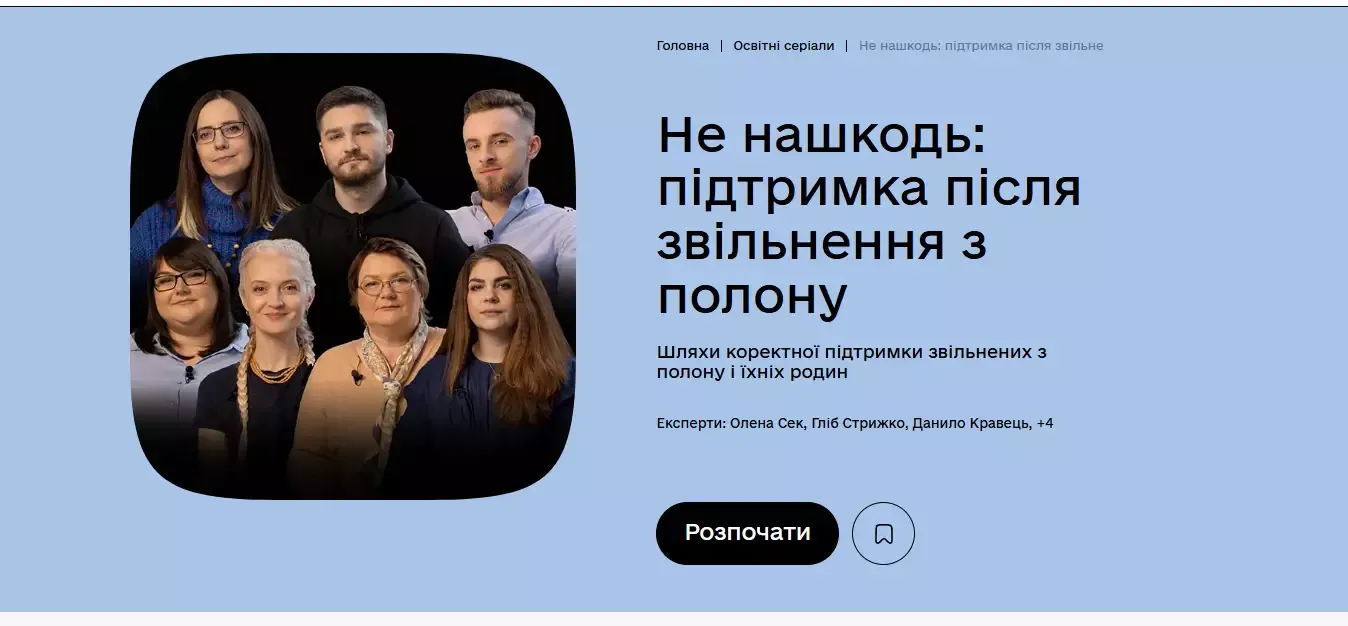
Another element of the initiative is the educational series "Do No Harm: Support After Release from Captivity," which is available on the Dія.Osvita platform.
In it, experts explain:
- how to properly support people after captivity;
- why the experience of captivity cannot be generalised;
- how to avoid stigmatisation;
- how to restore a sense of security and provide professional assistance.
Renowned Ukrainian experts, military psychologists, and people with experience of captivity contributed to the creation of the series and the development of the necessary tools:
- Olena Sek, head of the psychological training cycle commission, military psychologist, logotherapist, major in the Armed Forces of Ukraine;
- Glib Stryzhko, veteran, Chief Veterans Partner at Starlight Media, Veteran Hub ambassador;
- Danylo Kravets, officer of the post-isolation support department of the Joint Centre for Civil-Military Cooperation of the Armed Forces of Ukraine, consultant at Rivny-Rivny, sergeant of the Armed Forces of Ukraine with experience of captivity;
- Yulia Yevstratova, chief specialist in post-isolation support at the Reintegration Measures Department of the Central Civil-Military Cooperation Directorate of the General Staff of the Armed Forces of Ukraine, military psychologist, major in the Armed Forces of Ukraine;
- Hanna Mokrousova, chair of the Blue Bird NGO, psychologist;
- Tetiana Sirenko, chair of the board of the NGO "Resource Centre "Lisova Polyana"", clinical psychologist;
- Olena Kurta, head of the mobile group of volunteer combat resilience psychologists of the NGO "Institute of Health Psychology", psychologist.
"Captivity is the loss of your own world, where everything made sense. In forced isolation, a person has no control over their body, time or space," explains military psychologist Olena Sek in one of the series.
A series of videos with answers to difficult questions
As part of the initiative, an "Encyclopaedia of Difficult Questions" was also created — short videos in a "question and answer" format.
In them, experts explain
- how to support a person after captivity without causing harm;
- what you can and cannot ask;
- why excessive care can be harmful;
- how to talk to children about their parents' captivity;
- when it is necessary to consult a psychologist;
- how captivity affects the family;
- what "social quarantine" means after release.
The videos also discuss typical psychological reactions after torture and captivity and explain possible triggers that people face after their return.
These materials can be viewed on the social media pages of the "How are you?" programme.
The educational project was created in collaboration with DIGNITY — the Danish Institute Against Torture — with financial support from the Danish Ministry of Foreign Affairs.
The Coordination Centre for Mental Health of the Cabinet of Ministers of Ukraine, the General Staff of the Armed Forces of Ukraine, the Ministry of Veterans Affairs, media partner Starlight Media, and the non-governmental organisation "Barrier-Free" also joined the initiative.
More recommendations on proper communication and interaction with different people can be found in the Barrier-Free Handbook, created as part of an initiative by First Lady Olena Zelenska.